
 Slawomir Soroczynski - Global CIO: Fixed Income
Slow and Inconclusive End to Summer for the US Dollar
August was marked by broad US dollar weakness, a failed attempt to support the Japanese yen through coordinated intervention, and strong performance from commodity-linked currencies. Although hawkish comments from Federal Reserve Chair Kevin Warsh helped the dollar recover late in the month, investor sentiment remained broadly negative.
Dollar Weakness Remained the Dominant Theme
The dollar came under pressure after Treasury Secretary Scott Bessent announced an acceleration of longer-dated Treasury bond buybacks, a move interpreted by markets as an effort to lower borrowing costs and potentially tolerate a weaker dollar. The announcement pushed the dollar to a three-month low and drove bearish positioning to its weakest levels since the Iran conflict.
A partial recovery emerged near month-end after Fed Chair Kevin Warsh signalled that inflation remained too persistent to justify rate cuts. While his comments lifted the Bloomberg Dollar Spot Index, they failed to reverse the broader downward trend.
Yen Intervention Proved Ineffective
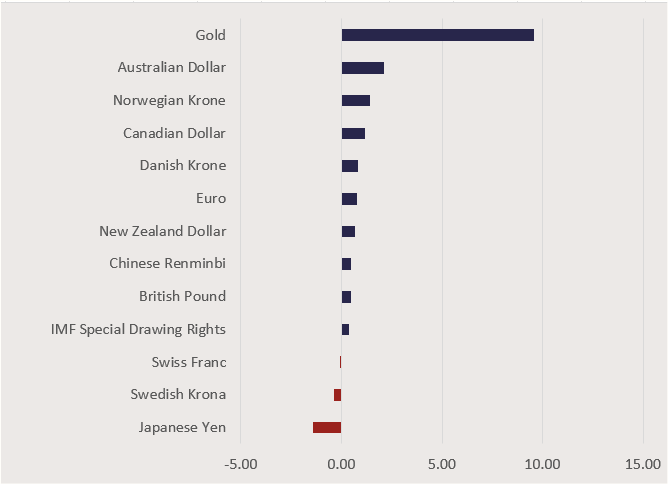
The Japanese yen was the weakest-performing G10 currency, falling 1.43% against the dollar despite the first coordinated US-Japan FX intervention in 15 years. Initial gains quickly faded as investors remained focused on yield differentials and capital flows.
By mid-month, the yen had surrendered much of its intervention-related rally, highlighting market scepticism about policymakers’ ability to support the currency without more significant monetary policy changes. The Swiss franc increasingly replaced the yen as the preferred carry-trade funding currency.
Commodity Currencies Outperformed
Commodity-linked currencies were the strongest beneficiaries of the weaker dollar and improving risk appetite.
- Australian dollar (AUD): +2.12%
- Norwegian krone (NOK): +1.42%
- Canadian dollar (CAD): +1.16%
Investors continued to favour currencies linked to commodities and global growth as confidence in the dollar deteriorated.
Euro Supported by Stronger Growth
The euro gained 0.78% against the dollar, supported by stronger-than-expected eurozone growth. Second-quarter GDP rose 0.4%, double consensus forecasts, prompting economists to revise 2026 growth expectations higher and boosting confidence in the region’s economic outlook.
Mixed Performance Elsewhere in Europe
The Swedish krona fell 0.40%, remaining the weakest G10 currency year-to-date. The Swiss franc was largely unchanged, declining just 0.09%, though it attracted increased interest as a carry-trade funding currency.
Technical Picture Remained Bearish
The US Dollar Index (DXY) repeatedly failed to sustain gains above 100.00 and later broke below both its 100-day and 200-day moving averages, reinforcing bearish sentiment and accelerating selling pressure. The index fell to a low of 98.55 before recovering following Warsh’s hawkish Jackson Hole remarks.
Despite the rebound, the DXY ended the month around 99.40, leaving the dollar below its early-August levels and signalling that investors remained unconvinced a durable recovery was underway.
Conclusion
August was defined by dollar weakness, ineffective yen intervention, and gains in commodity currencies. Although hawkish Fed rhetoric helped stabilise the dollar late in the month, bearish sentiment remained dominant. Commodity-linked currencies continued to benefit from shifting global macro expectations, while the dollar ended the summer lacking a clear catalyst for a sustained recovery.
Looking ahead, investors will closely watch central bank meetings, particularly in Japan, where a 50bp rate hike, once considered unthinkable, may become the Bank of Japan’s only remaining option.
August performance vs. USD (%)
Source: CAIM, 31 July 2026.
|